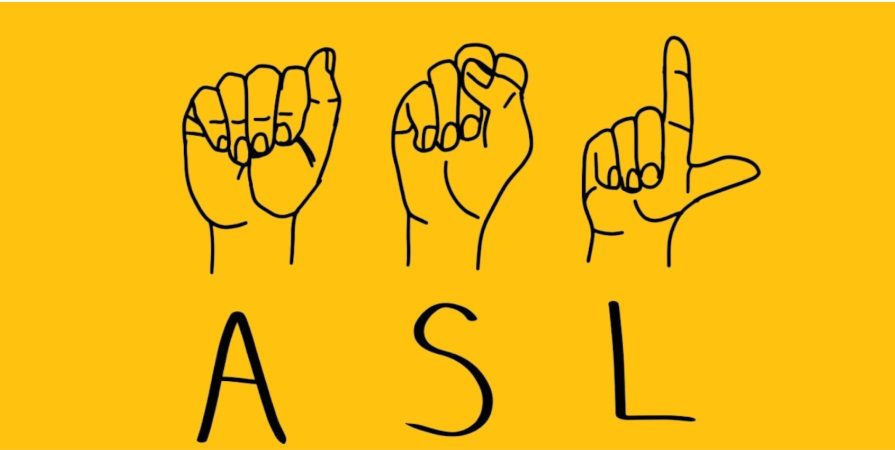
The American Sign Language Club has experienced significant growth this school year. During the 2024-2025 school year, the number of club members typically reached only about five people per meeting. This year, we have upwards of 20 people per meeting, and following this upgrowth in members, we have a lot of new people helping the ASL Club members learn sign language. This year, a new leader has joined the Club to assist the current club leader. Izzy Alexander (11), a veteran member of the club, has connected the ASL Club to our newest leader, Abby Lewis. Alexander met Lewis through a program called Young Life at her church, Northeast Christian Church, where Lewis is the youth leader. Lewis is going to be taking over as a sponsor for the ASL Club and providing the members with a lot more resources. She has been signing for about five years and graduated from the University of Louisville with a Bachelor’s in ASL and Human Services. Lewis explains her path to becoming fluent in ASL. According to her, she “really didn’t have much foreknowledge of ASL or Deaf culture before going into college.” However, Lewis notes that ASL“was always something that interested me, so when I saw UofL had an interpreting program, I decided to pursue that. I was never excited or extremely passionate about learning or anything specific, but when I started the ITP program, it was the first time I was genuinely excited to learn.”
At one of our latest ASL Club meetings, we had a deaf visitor named Elaine, whom Lewis knew and is friends with from Church. When asked if Elaine was born deaf or if she developed it over time, she said that at an early age, she had hearing loss, and it worsened as time went on. Elaine tells us how she prefers to communicate, explaining that “I enjoy sign language with those who sign. I wear a hearing aid to communicate with most people. If I don’t understand a person, I would ask him to write it down or use a voice-to-text app.” There isn’t just one answer to how to communicate when you meet a deaf person. Asking a deaf person about their preferences is important to help you better understand the conversation, and it is more comfortable for them to communicate the way they prefer.
After Elaine helped the ASL Club at their meeting, she gave insight into her experiences and the experiences of other deaf people through these responses. Firstly, Elaine explains she wanted people outside of the deaf and hard of hearing community to know about those in the community, and Elaine explained that “the deaf like people who want to learn the language of the deaf – ASL. As well, the deaf appreciate hearing people who take the time to learn ASL, and deaf people want to help hearing people improve in the language.”
Likewise, she continues saying that “the deaf are people who are proud of their language and culture and Deaf people can achieve a variety of roles in society including working in: healthcare, restaurants, an educational field, just to name a few.” Additionally, she elucidates that while sign language is very prevalent in the community “not all deaf people learn sign language. Some prefer to lip-read or use voice-to-text apps only.” Elaine also clarifies how people can spread awareness about the deaf and hard of hearing community. She explained that hearing individuals should “get involved in the Deaf community; these include Deaf church or Deaf ministry, Deaf fellowship, and Deaf social events, just to name a few. These are great places to improve in ASL, learn about deaf people and deaf culture.” She encourages people who are learning ASL or want to make communication easier for those in the deaf community to “use paper and pen and face the deaf person while speaking slowly. You can also use a voice-to-text or an ASL interpreter.” Elaine continues to explain what you need to know when you are learning ASL. She establishes that you shouldn’t “try to interpret for a deaf person while learning ASL. It takes college training to become an effective interpreter. ASL is a language. It has its own sentence structure and vocabulary. It’s different from spoken English.”
Elaine is now retired, but before she ran an ASL related business, she describes what her job entailed while she ran her business: “I would attend local and national events to showcase and sell my artwork. These events included workshops, conferences, and festivals. Most of these were ASL-led events. I would set up my vendor booth to showcase items in ASL, including greeting cards, bookmarks, mini easels, pictures, t-shirts, and needlework. Customers who don’t know sign language point at the items they want to purchase or have questions about. Because I wear a hearing aid, I understood most people. For those whom I had difficulty understanding, I would encourage them to write down their message. I also had an online store.” Furthermore, Elaine details how her job was able to assist those who needed help learning sign language, whether they were deaf or hearing. She says that “perhaps seeing a deaf person like myself having a business can encourage others to find their passion in life. It could be learning ASL or some other goal. I hoped my business motivated others to do what they enjoyed. One lady, for instance, told me that she wanted to start a business, and I encouraged her to “go for it!”
Overall, Elaine wanted people to know that “the deaf community is small, and we’re expanding by welcoming and socializing with the deaf and hearing people in our community. To those who can hear, this means those who are learning sign language or are fluent in ASL are welcome.” American Sign Language is difficult to learn and will take a while for you to become fluent. It usually requires college-level learning to be able to sign fluently. If you want to learn more about sign language, the ASL Club is the place for you.